Employers verify previous employment to confirm a candidate’s work history, role, dates of employment and, where relevant, reason for leaving. A careful check can identify accidental errors, unexplained gaps or material misrepresentations before an appointment is finalised. It should not, however, become an unrestricted search for personal information or an automatic reason to reject a candidate.
To verify previous employment in India, an employer usually combines the candidate’s consent and disclosures with an authorized HR response and appropriate supporting documents. This guide explains the process, commonly used records, the limited role of UAN and EPFO information, what “UAN employment verification” may mean, and how to handle non-response or discrepancies fairly.
What Is Previous Employment Verification?
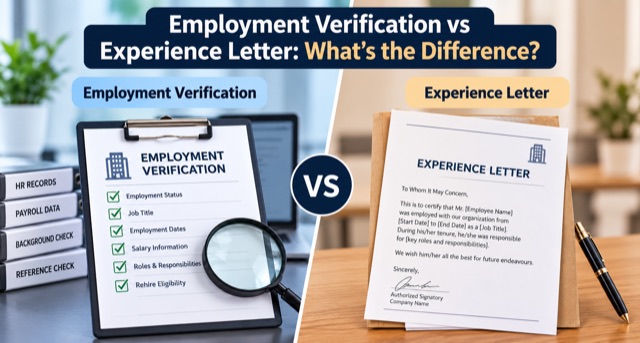
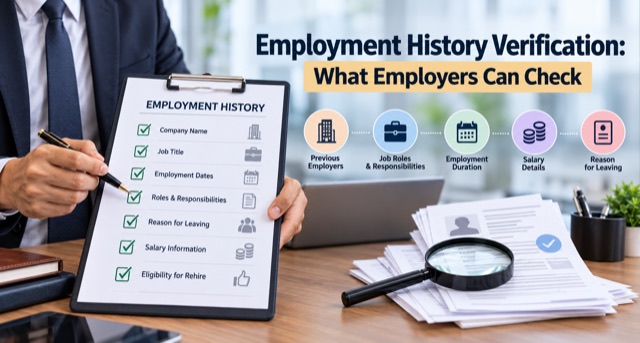
Previous employment verification is the process of checking whether a person worked for an organisation and whether key details—such as employer name, job title and employment dates—match the information supplied during recruitment. It is one part of employee background verification.
An employment check is narrower than a full background check. A broader check may include identity, address, education, professional qualifications, criminal-record searches where lawful and relevant, or reference checks. Each check should have a defined purpose and should use only information reasonably needed for the hiring decision.
The exact requirements are not identical for every job. They depend on the employer’s policy, the role, the sector, the records available and applicable law. A document or database entry can support a conclusion without proving every aspect of the person’s employment.
How to Verify Previous Employment in India
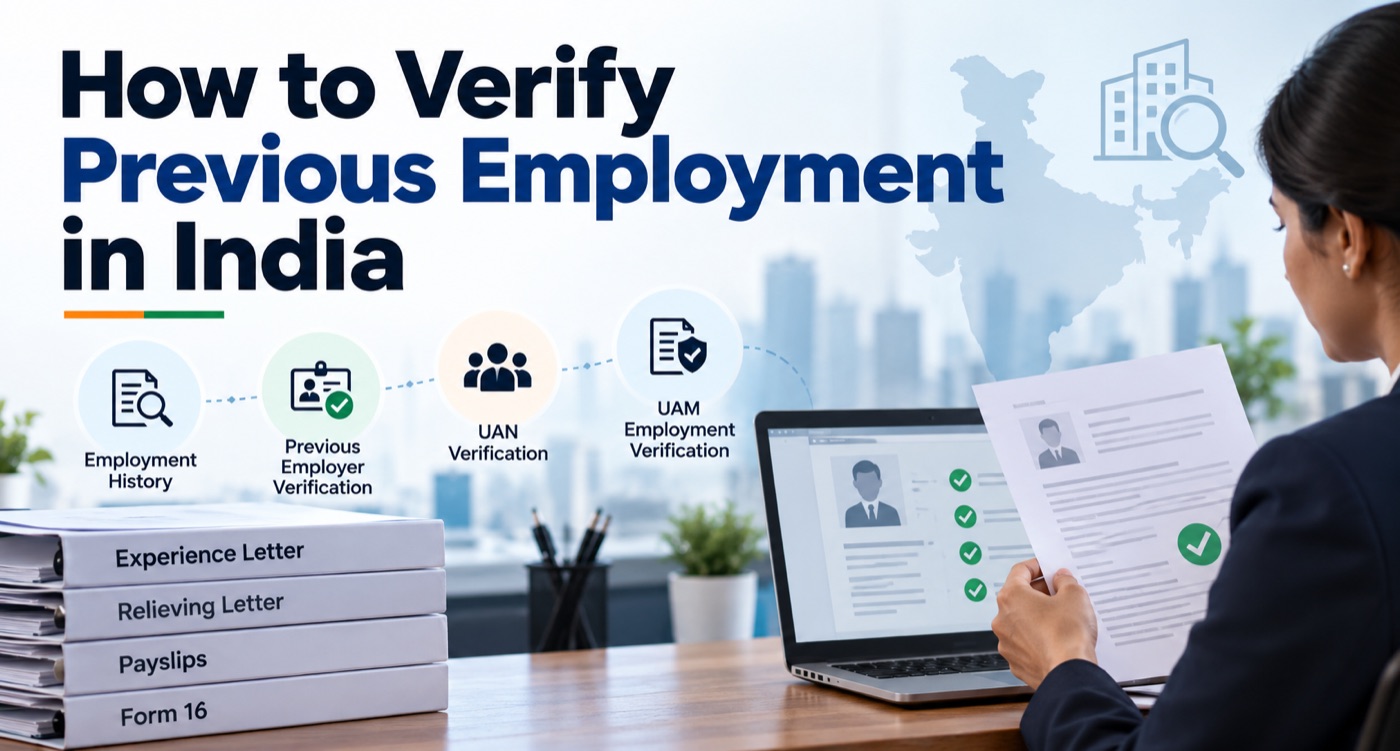
A practical HR employment verification process normally follows these steps.
1.Give the candidate notice and obtain appropriate consent. Explain what will be checked, why it is needed and who may receive the result. The Digital Personal Data Protection Act, 2023 describes consent as free, specific, informed, unconditional and unambiguous, and recognises employment-related processing in specified circumstances. Employers should still obtain clear, role-appropriate authorisation and follow their legal and privacy advice.
2.Collect the candidate’s employment details. Request the previous employer’s legal or commonly used name, location, employee or payroll reference if available, job title, employment dates and the authorised HR or verification contact. Ask the candidate to identify overlapping jobs, contract work, internships or periods of self-employment rather than assuming that every gap indicates a problem.
3.Request proportionate supporting documents. Depending on policy, these may include an offer or appointment letter, experience letter, relieving letter, payslips, Form 16, a separation document or another record that connects the candidate to the employer. Documents should be collected through a secure channel and reviewed for relevance, consistency and authenticity indicators.
4.Contact the previous employer through an official channel. Use a company-domain email address, published HR contact, verification portal or other channel that the previous employer identifies as valid. Ask factual questions within the candidate’s authorisation, such as whether the person worked there, the dates of employment and the last recorded designation. Avoid seeking confidential performance or medical information unless there is a lawful, necessary and clearly communicated basis.
5.Compare the available evidence. Check whether the employer response, candidate’s form and documents agree. A job title may differ because one source uses an internal grade and another uses a market-facing title. Dates may also differ by a few days because one record reflects joining, payroll activation or last working day. These differences should be examined rather than labelled as fraud immediately.
6.Resolve discrepancies and record the outcome. Give the candidate a reasonable opportunity to explain a material difference. Record the sources checked, the date of each attempt, the evidence received, the issue identified and the final status—for example, verified, verified with clarification, pending, inconclusive or unable to verify. Access to the report should be restricted to people who need it for the hiring decision.
Documents Required for Previous Employment Verification
No single document is universally mandatory or independently conclusive. Employers should use a combination that is proportionate to the role and available records.
| Document or source | What it can help verify | Important limitation |
| Experience letter | Employer identity, role and a stated period of service | May not show the exact joining or last working date; format and detail vary |
| Relieving or separation letter | That the employer recorded the person’s release or separation | A missing letter does not by itself prove that employment was false |
| Appointment or employment letter | Offer, proposed role, employer and start terms | It may show an intended appointment rather than completed service |
| Payslips or payroll records | Payroll relationship, pay period and sometimes designation | They may be incomplete, altered or unavailable for older employment |
| Form 16 | Tax-related salary reporting for a stated financial year | It is not a complete employment-history record and may not show all service details |
| Employer HR confirmation | Direct confirmation of selected employment facts | Depends on the employer’s records, response policy and authorised contact |
| EPFO/UAN-linked records | Certain provident-fund-linked member or service information | Coverage, dates and employer reporting may be incomplete or require clarification |
| Bank salary credits or tax records | Corroboration of payments for particular periods | A payment does not, by itself, establish the full role, duties or employment terms |
Documents should be accepted only through a process that protects personal information. Employers should not ask candidates to disclose passwords, one-time passwords or unrestricted account access.
How UAN Verification Helps Verify Previous Employment
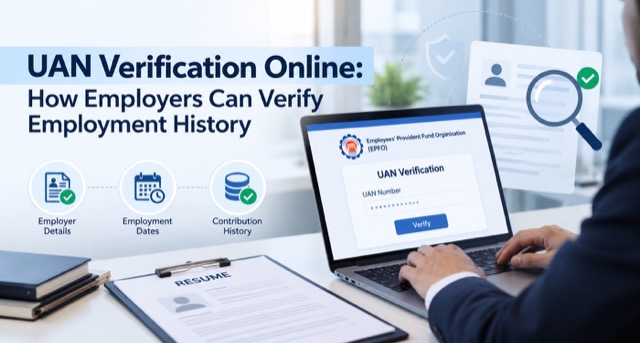
The Universal Account Number, or UAN, is a 12-digit number used in the Indian EPFO system. EPFO states that the UAN is allotted to a subscriber and connected with member accounts, and that members can activate it and access services such as their passbook. EPFO’s official website also provides member access to EPF account and transaction information.
With the candidate’s appropriate authorisation and through a lawful, approved process, relevant EPFO-linked information may help corroborate that provident-fund contributions or member records are associated with an establishment during particular periods. This can be useful where an employer is closed, has changed its contact details or does not respond promptly.
UAN or EPFO information has important limits. It may not cover work that was outside EPF coverage, short engagements, informal work, some contractor arrangements or periods where records were not correctly filed. A record may also contain errors, delayed updates, duplicate member IDs or an employer name that differs from the trading name. It generally cannot establish every detail of a person’s duties, seniority, performance, reason for leaving or whether the person worked continuously throughout a period.
UAN verification should therefore be treated as corroborative evidence, not a conclusive substitute for all other checks. Collect only what is necessary, explain the purpose, use secure systems and retain the information only as long as required. Never request the candidate’s UAN password or OTP.
What Is UAN Employment Verification?
“UAN employment verification” is not established in the official sources reviewed as a standard Indian employee-verification method comparable to UAN or an EPFO service-history check. In Indian government and MSME materials, UAN commonly refers to the Udyog Aadhaar Memorandum, an older MSME registration term. The Ministry of MSME has published material concerning UAN and the transition to Udyam Registration; current MSME communications use Udyam Registration as the relevant registration framework.
A UAN or Udyam registration relates to an enterprise, not proof that a particular individual worked for that enterprise. It should not be presented as an employee database or as a substitute for previous employer verification. If a vendor, form or internal checklist uses “UAN employment verification,” ask the provider to define the acronym and identify the underlying official record. It may be a mistaken reference to UAN, an internal product label or an enterprise-registration check. Do not invent a government portal or claim a verification capability that cannot be evidenced.
What If the Previous Employer Does Not Respond?
Non-response is common when a business has closed, HR staff have changed or the organisation answers verification requests only through a central portal. It should not automatically be treated as proof of fraud.
An employer can take these steps:
•Send a documented follow-up through another official HR or payroll channel.
•Ask the candidate for additional, relevant records such as an experience letter, relieving letter, payslips, Form 16 or bank salary evidence.
•Corroborate the employment period and designation using more than one independent source.
•Mark the check as pending or inconclusive if the evidence is insufficient, rather than converting silence into a negative finding.
•Give the candidate an opportunity to explain the missing response or any discrepancy.
The final report should distinguish “not verified because the source did not respond” from “evidence contradicts the candidate’s statement.” Those are materially different outcomes.
Common Challenges in Employment Verification
The most frequent issues include incorrect employment dates, differences between internal and external job titles, closed businesses, unavailable HR contacts, missing documents and incomplete historical records. Candidate disclosures may also combine a group company name with a legal payroll entity, creating an apparent mismatch.
A fair review begins by checking whether the sources use the same date convention. For example, one record may show the last working day while another shows the date on which payroll ended. HR should also check whether a person was employed directly, through a staffing company or as a consultant. Material contradictions should be documented and discussed with the candidate before an adverse decision is made.
Best Practices for Employers and HR Teams
•Use a written, role-appropriate verification policy and apply it consistently.
•Give notice and obtain consent or rely on another lawful basis where applicable; explain the purpose and scope clearly.
•Collect the minimum information needed for the decision and do not request passwords or OTPs.
•Restrict access to reports and encrypt or otherwise secure documents in transit and storage.
•Use official contact channels and preserve an audit trail of requests and responses.
•Report facts and source limitations separately from opinions or risk labels.
•Give candidates a fair opportunity to correct errors and explain discrepancies.
•Define retention and deletion rules. Under the DPDP Act, a Data Fiduciary has obligations relating to security safeguards and erasure when the specified purpose is no longer being served, subject to legal retention requirements.
Frequently Asked Questions
1. How can I verify previous employment in India?
Obtain appropriate authorisation, collect the candidate’s employer and role details, review relevant documents, contact the previous employer through an official channel, compare the evidence and record a reasoned outcome. The precise process depends on the employer’s policy, role and applicable law.
2. Which documents are required for employment verification?
There is no universal list for every job. Experience letters, relieving letters, appointment letters, payslips and Form 16 may help, but each has limitations. Use the combination that is relevant and reasonably necessary.
3. Can UAN be used to verify previous employment?
It can support verification where relevant EPFO-linked records exist and are accessed lawfully. It is not a complete record of every job and does not independently prove all employment details.
4. Can employment be verified without contacting the previous employer?
Sometimes. Documents, EPFO-linked evidence and independent corroboration may support a conclusion, particularly when the employer is unavailable. The result should state the sources used and any remaining uncertainty.
5. What happens if employment dates do not match?
Check the date definitions, payroll or contractor arrangements and source quality. Ask the candidate for an explanation, seek clarification where possible and document whether the difference is immaterial, explained, unresolved or materially contradictory.
6. How long does previous employment verification take?
There is no universal timeline. It depends on the employer’s response, the age and completeness of the records, the number of employers checked and whether additional clarification is needed.
7. Is previous employment verification mandatory for every job?
Not necessarily. Whether it is required depends on the employer’s policy, the role, sector-specific expectations and applicable law. Employers should avoid collecting more personal information than the hiring purpose requires.
Conclusion
Reliable previous employment verification in India combines a candidate’s disclosures, proportionate documents, official HR confirmation and—where appropriate—lawfully accessed EPFO/UAN evidence. No single document or database should be treated as conclusive in every case. A defensible process records its sources, investigates discrepancies fairly, distinguishes non-response from contradiction and protects personal information throughout.