Resposta rápida:
Employment history verification is the process of checking whether a candidate’s previous employers, job titles, employment dates, responsibilities, and other work details are accurate. Employers may review application forms, experience letters, payroll records, references, UAN or EPFO-related information, and confirmation from previous employers. The exact checks should match the role and be carried out with appropriate authorisation.
A resume is a useful starting point, but it is not independent proof of employment. A candidate may describe the right company but give an incorrect date. A job title may be simplified. A short contract may be presented as permanent employment. These differences are not always intentional, which is why a fair verification process checks the evidence before reaching a conclusion.
What Is Employment History Verification?
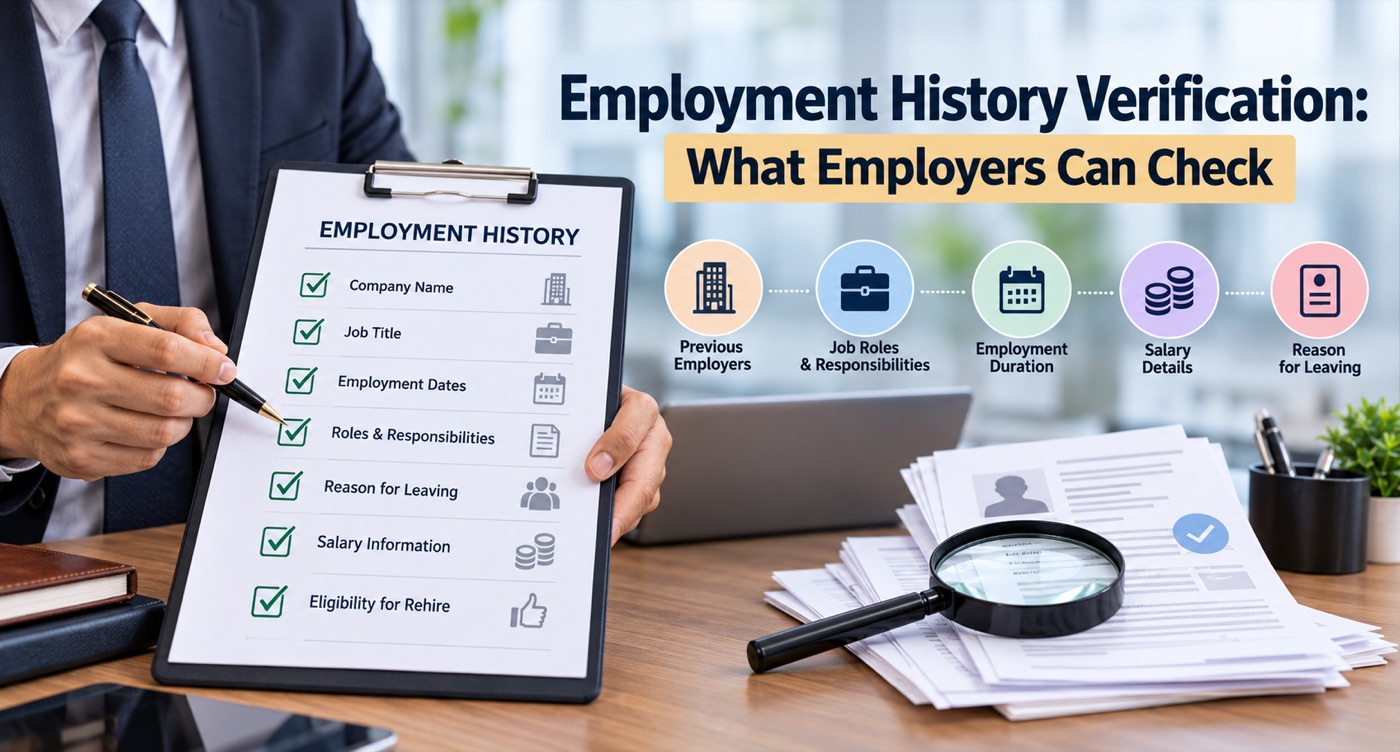
Employment history verification is a background check that confirms a candidate’s previous work information with reliable sources. Depending on the role and the employer’s policy, the process may verify the organisation, job title, joining date, last working date, employment status, department, salary, reporting manager, reason for leaving, or rehire eligibility.
The information available depends on the source. A previous employer may confirm dates and designation. Salary slips may support compensation details. A UAN or EPFO-related record may provide additional employment evidence where authorised records are available. No single source necessarily confirms every part of a candidate’s work history.
Why Is Employment History Verification Important?
Employment verification helps employers make decisions based on more than a resume or interview. It can help the organisation:
•confirm that the candidate worked for the stated employers
•check whether employment dates are broadly accurate
•validate experience relevant to the position
•identify unexplained gaps or overlapping periods
•reduce the risk of false or exaggerated claims
•meet client, contractual, industry, or internal screening requirements
•decide whether additional background checks are appropriate.
The purpose is not to assume that every candidate is dishonest. In many organisations, employment history verification is a standard part of background verification and is applied consistently to shortlisted candidates.
What Can Employers Check During Employment Verification?
The scope should be proportionate to the role. An employer does not need to collect every available detail simply because it can.
| Employment detail | What an employer may check | Common source |
| Employer name | Whether the candidate worked for the stated organisation | Previous employer, official records |
| Cargo | Designation held during employment | HR confirmation, experience letter |
| Data de admissão | When the employment began | Employer record, offer letter |
| Último dia de trabalho | When the employment ended | Employer record, relieving letter |
| Department | Business unit or function | Employer confirmation, HR documents |
| Situação do vínculo | Permanent, temporary, contract, or consultant status | Employer, contract documents |
| Salário | Compensation or last drawn salary, where relevant and permitted | Salary slips, employer confirmation |
| Responsibilities | Whether the stated work matches the role | Employer, manager, references |
| Motivo da saída | Separation information, where the source provides it | Previous employer, candidate explanation |
| Rehire status | Whether the person may be eligible for rehire, where available | Empregador anterior |
Not every employer will release every detail. Some organisations have policies that limit responses to dates, job title, and employment status.
How Does Employment History Verification Work?
A well-managed process usually follows these steps.
1. Decide the scope
Define which employment periods and details are relevant to the role. A finance position may require closer confirmation of responsibilities and tenure than a short-term, low-risk assignment.
2. Inform the candidate
Explain the purpose of the employment history verification, the information being collected, and how the result will be used. Obtain appropriate consent or authorisation before approaching third parties or using an external screening provider.
3. Collect candidate information
Ask for the details needed to conduct the check. This may include employer names, work locations, job titles, dates, employee numbers, HR contacts, experience letters, relieving letters, salary slips, and other supporting documents.
4. Contact the relevant source
The employer or screening provider may contact the previous organisation through an official HR channel, a designated verification portal, a documented email address, or another authorised route. Where appropriate, other records may be used to supplement the employer response.
5. Compare the evidence
Compare the response with the candidate’s application, resume, and documents. Mark the result as verified, pending, discrepant, or unable to verify according to the organisation’s process.
6. Resolve discrepancies
Give the candidate an opportunity to explain a material difference. A mismatch may be caused by a notice period, payroll cut-off, transfer between group companies, staffing agency arrangement, name variation, or administrative error.
7. Record the decision
Document the sources reviewed, the information confirmed, any unresolved issue, and the reason for the final assessment. The hiring decision should consider the role and the full screening context rather than one isolated mismatch.
| Process stage | Employer action |
| Planning | Decide what must be checked |
| Authorisation | Inform the candidate and obtain permission |
| Information collection | Gather work history and supporting documents |
| Verificação | Contact the relevant source |
| Comparison | Check the response against candidate claims |
| Esclarecimento | Investigate material differences |
| Reporting | Record verified, pending, and discrepant items |
What Documents Support Employment History Verification?
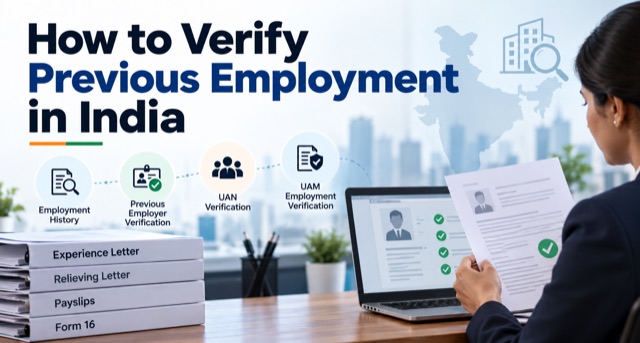
BGV Documents can help an employer understand the candidate’s work history and resolve questions. Common examples include:
•experience or service certificate
•relieving or separation letter
•offer or appointment letter
•salary slips
•Form 16 or other permitted payroll documentation
•resignation acceptance email
•promotion or transfer letter
•employment contract
•professional reference details.
A document should be reviewed for consistency rather than accepted without question. Employers should also avoid requesting unnecessary sensitive information.
Can UAN or EPFO Records Support Employment Verification?
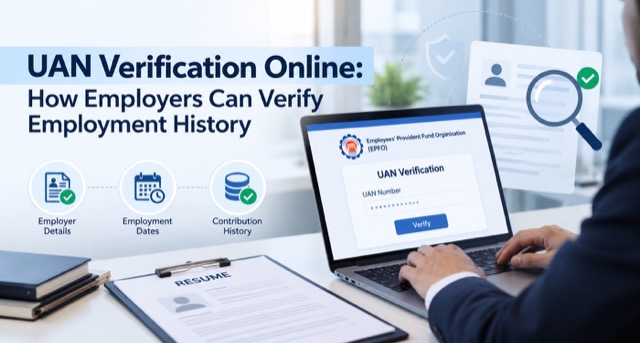
Yes, available UAN or EPFO-related information may support employment history verification when reviewed through an authorised process. It may help an employer compare recorded employer associations, provident fund contribution activity, and certain employment-related dates.
However, UAN verification is not a complete employment history report. It may not show overseas employment, work outside the relevant EPFO-covered arrangements, or every historical record. It also does not independently confirm job title, responsibilities, salary, performance, or reason for leaving.
| UAN or EPFO-related information may support | Usually needs separate confirmation |
| Recorded employer association | Job title and seniority |
| Atividade de contribuição | Daily responsibilities |
| Some employment-related dates | Salary and benefits |
| Possible period requiring clarification | Performance and conduct |
| Comparison with candidate declarations | Motivo da saída |
Employers should never request a candidate’s EPFO password or OTP. A UAN number alone is not permission to access private account information.
Employment History Verification vs Background Checks
Employment history verification is one part of a wider background check. The correct scope depends on the job, industry, location, level of access, and employer policy.
| Verificação | Main purpose |
| Verificação de histórico profissional | Confirm previous work information |
| Verificação de identidade | Confirm that the candidate is the person named in the application |
| Verificação de formação acadêmica | Confirm degrees, diplomas, or qualifications |
| Verificação de endereço | Confirm current or previous residence information |
| Criminal-record check | Review relevant court or criminal records through appropriate sources |
| Reference check | Obtain role-related feedback from a former manager or reference |
| Verificação de licenças | Confirm that a regulated professional licence is valid |
| Right-to-work check | Confirm permission to work where relevant |
A company should not order every possible check for every candidate. Screening should be relevant, explained to the candidate, and handled responsibly.
Common Employment Verification Problems
Date mismatch
Dates can differ because of notice periods, payroll processing, internal transfers, or data-entry mistakes. Ask for clarification before treating the difference as a serious concern.
Job title mismatch
A candidate may use an industry-standard title while the employer uses an internal title. Compare the actual responsibilities as well as the wording of the designation.
Employer does not respond
A former employer may have a limited verification policy or may not respond promptly. Marking the check as pending or unable to verify is more accurate than automatically treating it as failed.
Missing documents
Request only the documents needed to resolve the issue. If a document cannot be provided, consider another reliable source.
Staffing or third-party employment
A candidate may have worked at a client site while being employed by a staffing agency. The resume, payroll records, and employer response may use different names. Clarify the arrangement before reaching a conclusion.
Unexplained gap
A gap may relate to study, personal responsibilities, health, travel, business activity, or job searching. The candidate should have an opportunity to explain it.
Melhores práticas para empregadores
A practical employment history verification policy should:
1. Define the checks before the hiring process begins
2. Apply the same basic process to comparable candidates
3. Explain the purpose and scope to candidates
4. Obtain appropriate authorisation
5. Use reliable and documented sources
6. Protect personal information
7. Separate verified, pending, and discrepant findings
8. Give candidates a fair chance to clarify material differences
9. Keep a record of the evidence supporting the final decision.
Technology can help organise requests, documents, reminders, and reports. It does not remove the need for human review. An automated match can be wrong, especially where names, dates, or group-company records are similar.
How Quinfy Can Support Employment Verification
Quinfy’s published employment verification service describes direct checks with previous employers, including written or telephone confirmation. The service page also lists identity, education, employment, criminal, and professional-reference checks.
Direct employer confirmation can complement UAN or EPFO-related evidence when an organisation needs to verify job title, employment dates, salary, responsibilities, or separation details. Quinfy also describes a workflow in which employers submit candidate information and documents, select relevant checks, and receive the outcome through its verification process.
Perguntas frequentes
What is employment history verification?
Employment history verification checks whether a candidate’s previous employers, job titles, dates, and other work details are accurate. Employers may use previous-employer confirmation, documents, references, and authorised records.
What do employers check in employment history verification?
Employers commonly check the organisation name, job title, joining date, last working date, employment status, department, and sometimes salary, responsibilities, reason for leaving, or rehire status.
How is employment history verified?
The employer defines the scope, informs the candidate, obtains appropriate authorisation, contacts relevant sources, compares the evidence with the application, and investigates material discrepancies before recording the result.
Os empregadores podem verificar o histórico profissional usando o UAN?
Available UAN or EPFO-related information may support employment verification when accessed through an authorised process. It should be compared with documents and direct employer confirmation where necessary.
Does employment verification confirm salary?
It can confirm salary only when the employer or appropriate salary documents provide that information. Salary is not automatically established by every employment record.
What if a previous employer does not respond?
Record the check as pending or unable to verify according to the employer’s policy. Request alternative documents or use another reliable source instead of automatically treating the candidate as dishonest.
Is consent required for employment history verification?
Employers should use an appropriate consent or authorisation process and explain what information will be checked. They should also follow applicable privacy and data-handling requirements.
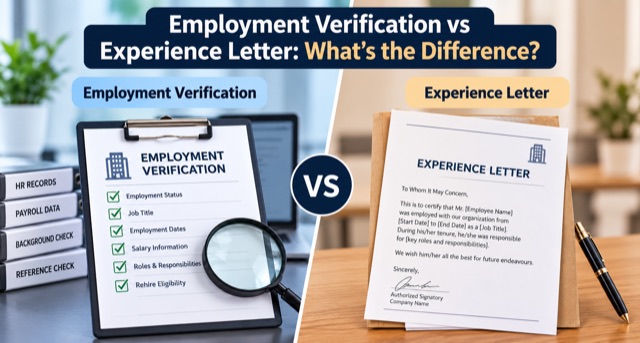
Is employment verification the same as a background check?
No. Employment verification focuses on work history. A broader background check may also include identity, education, address, criminal-record, reference, licence, or role-specific checks.
Conclusão
Employment history verification helps employers confirm whether a candidate’s professional background matches the information provided during recruitment. It may cover employers, dates, titles, responsibilities, salary, and separation details, but the available evidence depends on the source. The most reliable approach combines direct employer confirmation, document review, authorised UAN or EPFO-related checks where relevant, and fair investigation of discrepancies.