An experience letter is a document issued by a previous employer to record a person’s work experience. Employment verification involves checking whether appropriate sources can confirm the candidate’s stated employer, dates, designation, and other relevant details. An experience letter can support a verification check, but it is not the same as independent employment verification.
This distinction matters during background verification and wider background checks. A recruiter may receive a perfectly formatted letter, yet still need to confirm whether the dates and designation match the former employer’s records. On the other hand, a candidate may have genuinely worked somewhere but be unable to produce the letter. Good verification processes leave room for both possibilities instead of treating every mismatch as a red flag.
What Is Employment Verification?
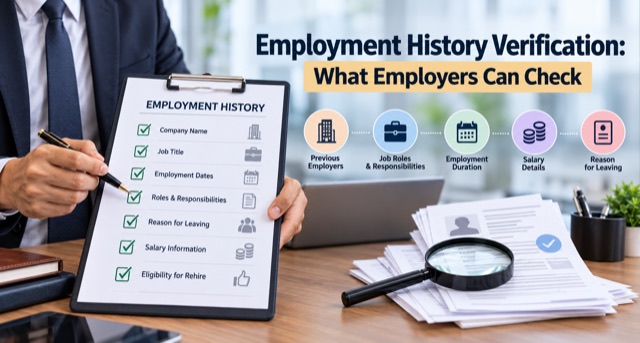
Employment verification is a check of a candidate’s previous work history. An employer or authorised background verification provider may contact a former employer or review other appropriate records to confirm information supplied during recruitment.
Depending on the scope of the check and the records available, the verifier may confirm:
•The previous employer’s name
•Joining and last working dates
•Job title or designation
•Department or employment status
•Nature of employment, such as full-time, part-time, or contract work
•Other details relevant to the role and the employer’s verification policy
The information confirmed is not always the same in every case. A former employer may have a policy of sharing only basic dates and designation. Some organisations respond through an HR portal, while others reply by email or phone. The checks should therefore be understood as a process with a defined scope, not as a guarantee that every detail of a person’s working life will be available.
In India, employment verification is commonly conducted as part of employee background verification, or BGV. It may be performed by an internal HR team or by an authorised screening provider. Candidate consent and a clear explanation of the information being checked are important parts of a responsible process.
The practical goal is employment history verification: comparing what a candidate has declared with what can reasonably be confirmed. That does not mean every former employer will share every detail. Many companies limit their responses to basic facts such as dates and last designation.
What Is an Experience Letter?
An experience letter is a formal document issued by an employer, usually when an employee leaves the organisation or completes a period of employment. It records that the person worked for the organisation and may mention the designation, employment period, department, or a brief description of the role.
The format varies between employers. A letter may include the employee’s name, company name, dates of employment, job title, issuing authority, date of issue, and an official signature or contact detail. Some employers use the term service certificate for a similar document.
An experience letter is useful evidence, but it does not necessarily answer every question an employer may have. It may not include the exact reason for separation, reporting manager, rehire status, salary, or the full scope of the candidate’s responsibilities. It is also possible for a genuine document to contain an administrative error. For that reason, the letter should be read alongside the candidate’s application and the requirements of the particular check.
Experience letter vs relieving letter
An experience letter generally documents the work experience gained during employment. A relieving letter usually confirms that the employee was released from the organisation after completing the required exit process.
Some companies issue both documents, some combine the information, and others follow different internal practices. They are related, but they are not automatically interchangeable.
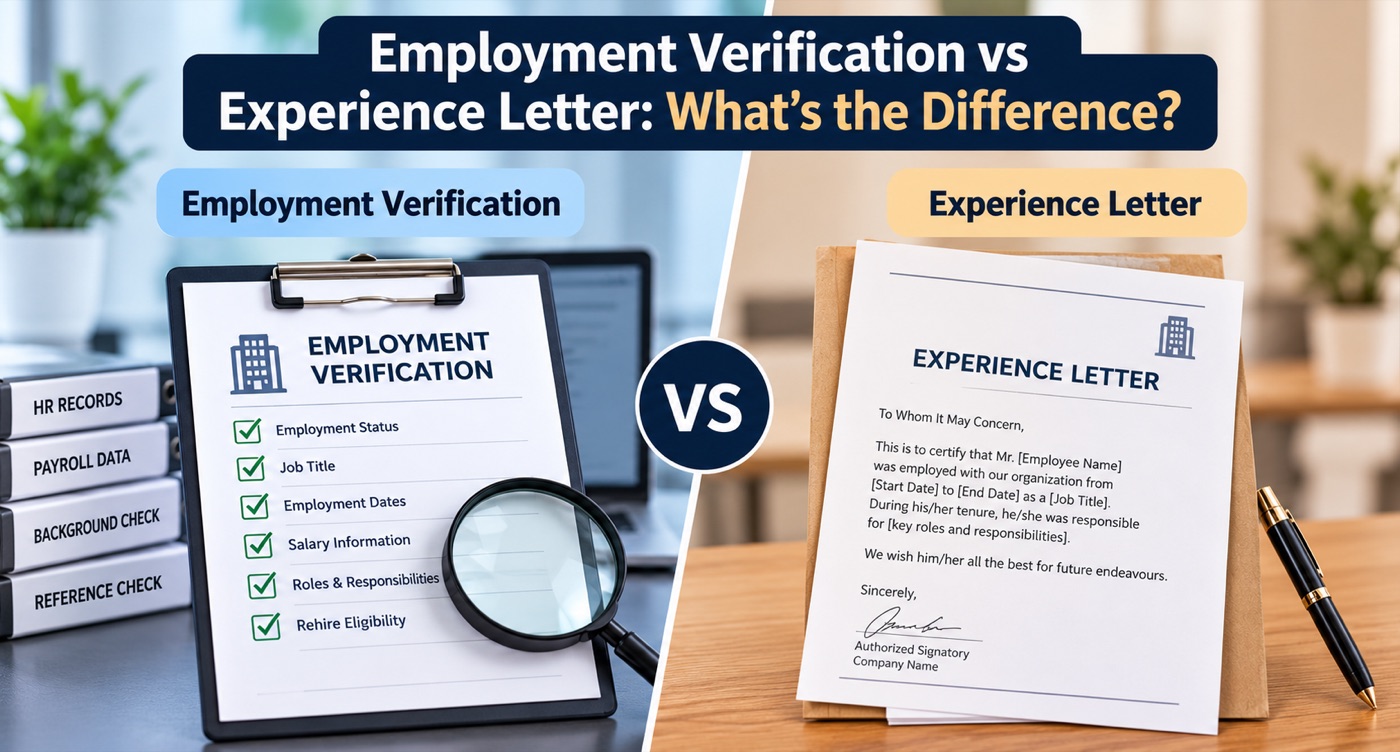
Employment Verification vs Experience Letter: Key Differences
| Comparison factor | रोज़गार वेरिफिकेशन | Experience letter |
| अर्थ | A process used to confirm employment information | A document issued by an employer |
| Main purpose | To check whether relevant employment claims can be confirmed | To record a person’s work experience |
| Main source | Former employer, authorised records, and supporting evidence | The employer that issued the letter |
| Format | May involve a portal, email, phone call, records, or a structured check | Usually a formal letter or certificate |
| Employment dates | May be confirmed against available employer records | May be stated in the document |
| पदनाम | May be independently confirmed where the source provides it | May be mentioned in the letter |
| Independence | Can include confirmation from a source other than the candidate | Is normally submitted by the candidate as supporting evidence |
| Common use | Recruitment and employee background checks | Job applications and employment documentation |
The simplest way to remember the difference is this: an experience letter provides evidence; employment verification is the process of checking the employment claim.
Is an Experience Letter Enough for Employment Verification?
Sometimes it may meet an organisation’s requirement, but not always. Whether an experience letter is sufficient depends on the role, the information the employer needs to confirm, the organisation’s policy, and whether the issuing employer can be identified and contacted.
Additional verification may be appropriate when:
•The dates in the letter do not match the candidate’s application.
•The stated designation differs from other information provided.
•The employer or signatory cannot be confirmed through reliable contact details.
•The hiring organisation requires independent confirmation.
•The candidate does not have an experience letter.
•Other records conflict with the document.
A mismatch should not automatically be treated as proof of fraud. Dates can differ because of notice periods, transfers between group companies, payroll cut-off dates, or simple reporting mistakes. A fair process gives the candidate an opportunity to explain the difference before the employer reaches a conclusion.
How Do Employers Verify an Experience Letter?
Checking an experience letter and verifying employment are related activities, but they answer different questions. A practical process may look like this:
1. Collect the document and candidate details
The HR team obtains the experience letter through its normal recruitment process. It also records the employer name, candidate’s stated dates, designation, and the authorised contact details needed for the check.
2. Review the document for consistency
The reviewer checks the name, company details, dates, designation, issuing authority, letter date, and contact information. Formatting or visual review can identify issues for follow-up, but it cannot by itself prove that a document is genuine or that all of its contents are accurate.
3. Confirm the previous employer’s identity
The verifier should use reliable contact information rather than relying only on a phone number or email address printed on the submitted document. The aim is to ensure that the response comes from an appropriate organisation or authorised representative.
4. Contact the former employer when appropriate
The verifier requests confirmation of the relevant employment details through an authorised channel. The information requested should match the agreed scope of the check and should be handled with appropriate consent and privacy safeguards. The Digital Personal Data Protection Act, 2023 is an important official reference for India’s personal-data framework.
5. Compare the response with the candidate’s claim
The response is compared with the experience letter, application form, resume, and any other relevant evidence. The result may be confirmed, pending, or discrepant depending on the records and the provider’s reporting method. If the former employer does not respond, that is a limitation of the check; it is not automatically evidence that the candidate made a false claim.
Experience Letter Verification vs Employment Verification
Experience letter verification focuses mainly on the submitted document. The reviewer considers whether the issuing organisation, dates, designation, and other details appear consistent and whether the document can be validated.
Employment verification focuses on the underlying employment claim. It asks whether the person worked for the stated organisation and whether relevant details can be confirmed through an appropriate source.
A document can look genuine and still contain an incorrect date or title. Conversely, a candidate may have genuinely worked for an organisation but be unable to provide a letter because the company closed, changed its HR system, or simply did not issue one. That is why document review and independent confirmation are best treated as complementary steps.
Where UAN Verification fits
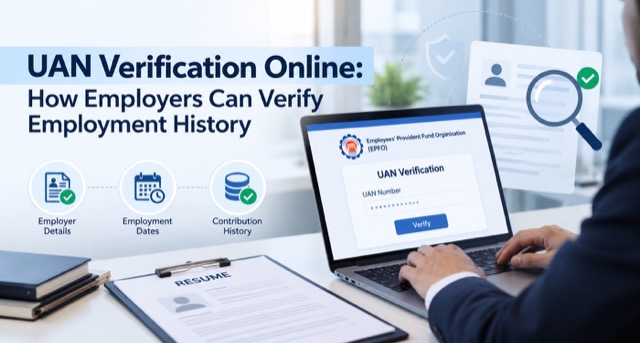
UAN Verification can be useful as a supporting check when the candidate’s employment was linked to the Employees’ Provident Fund system. Depending on the records available and the process being used, EPFO-linked information may help cross-check an employer name or contribution period.
It should not be treated as a complete substitute for employer confirmation: UAN or EPFO information generally does not establish everything an HR team may want to know, such as job title, responsibilities, performance, or reason for leaving.
This is also why a sensible background verification process uses more than one piece of evidence where the role or situation calls for it. UAN Verification, an experience letter, salary records, and a former-employer response may each answer a different part of the question.
What Documents Can Support Employment Verification?
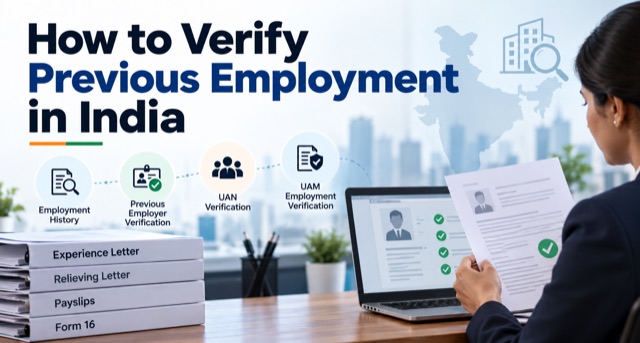
The right evidence depends on the verification scope. Documents that may help include an experience letter, relieving letter, appointment or offer letter, salary slips, Form 16, employee-provided employment records, and a reference or confirmation from the former employer.
Not every document is required in every case. A salary slip may help support a period of employment, but it does not necessarily confirm the employee’s full role history. An appointment letter may show the original terms, but not the last working date. No single document proves every aspect of an employment relationship.
What Should HR Do If an Experience Letter Is Missing?
A missing letter should prompt a reasonable follow-up, not an automatic rejection. HR teams can ask the candidate why the document is unavailable and request alternative evidence where appropriate. They may also contact the former employer using reliable, authorised channels or review other records that fit the verification policy.
The team should record the checks completed, keep unresolved issues separate from confirmed discrepancies, and give the candidate a fair opportunity to clarify conflicting information. Applying the same process to candidates in similar circumstances helps reduce arbitrary decisions and supports a more consistent candidate experience.
Why Employment Verification Matters in Recruitment
Employment verification helps employers to compare the information supplied during recruitment with information that can be confirmed by relevant sources. It can bring inconsistencies to light, reduce over-reliance on a single document, and support better-informed decisions for roles where previous experience matters.
It is worth keeping the purpose in perspective. Background checks are not meant to turn a hiring process into an investigation of a candidate’s entire personal life. A good check is focused on the role, uses relevant information, and gives the candidate a chance to explain a result that does not line up at first glance.
It does not eliminate every hiring risk. Former employers may have incomplete records, different disclosure policies, or no response. The value of the check depends on its scope, the quality of the sources, and how carefully the result is interpreted. It should be used alongside interviews, skills assessment, references, and other role-relevant checks rather than as a substitute for them.
How Quinfy Can Support Employment Background Verification
Quinfy’s employment background verification service describes employment checks that contact previous employers and validate relevant details in writing or by phone. The page also lists employment verification alongside other checks that may form part of a wider background screening package, depending on business requirements.
For a hiring team, this can be helpful when employment history verification needs to be handled consistently across several candidates rather than through scattered calls and email follow-ups. The exact checks should still be selected according to the role and the employer’s policy; no provider can confirm information that a source does not hold or will not disclose.
For HR teams, the practical benefit is a structured way to collect candidate information, submit documents, and request the checks needed for a particular role. The appropriate scope should be agreed in advance, with candidate consent and a clear process for handling pending responses or discrepancies. To discuss a requirement with Quinfy, HR teams can contact the company.
अक्सर पूछे जाने वाले प्रश्न
What is the difference between employment verification and an experience letter?
An experience letter is a document issued by a previous employer that records a person’s work experience. Eployment verification is the process of confirming the candidate’s employment details through appropriate sources. The letter can support the check, but it is not the same as independent confirmation.
Is an experience letter enough for employment verification?
It can be enough when the hiring organisation’s policy accepts it and the document contains the required information. Additional confirmation may be needed when dates, designation, employer identity, or other details are unclear or inconsistent, or when the role requires independent verification.
How do employers verify experience letters in India?
They may review the document, confirm the previous employer’s identity, contact an authorised HR representative, and compare the response with the candidate’s declarations and supporting records. The exact method depends on consent, the employer’s disclosure policy, available records, and the scope of the check.
Can employment be verified without an experience letter?
Yes. A former employer may confirm employment directly, and other records such as an appointment letter, salary slips, Form 16, or an authorised reference may provide supporting evidence. The documents required depend on what the employer needs to verify.
What is the difference between an experience letter and a relieving letter?
An experience letter generally records the work experience gained during employment. A relieving letter generally confirms that the employee was released after completing the exit process. Employers use different formats, so the documents may overlap in some cases but should not be assumed to be identical.
What happens if an experience letter contains incorrect information?
The employer should compare it with other available information and ask the candidate or issuing organisation for clarification. An error may be administrative rather than intentional. The result should be documented accurately, and the candidate should have a reasonable opportunity to respond to a material discrepancy.
Can an employer reject a candidate who does not have an experience letter?
An employer may set document requirements for a role, but a missing experience letter does not automatically establish that employment was false. HR can consider alternative evidence and direct employer confirmation, then apply its stated policy consistently and in a manner appropriate to the role.
Which documents are required for employment verification?
Requirements vary. Common supporting documents include an experience or relieving letter, appointment letter, salary slips, Form 16, and former-employer contact details. A verifier should request only information relevant to the agreed check and should not assume that every listed document is necessary.
Is experience letter verification the same as background verification?
No. Experience letter verification is one document-focused activity. Background verification is broader and may include employment, education, identity, address, criminal-record, licence, and reference checks. The checks included depend on the role, employer policy, consent, and applicable requirements.
निष्कर्ष
An experience letter documents a person’s employment history, while employment verification checks whether relevant employment claims can be confirmed through appropriate sources. The two are not competing alternatives: a letter can provide useful evidence, and independent verification can test the accuracy of the information it contains. For support with structured employment and background checks, HR teams can explore Quinfy’s employment verification services.